
Prospecting starts with the company, not the contact. Why enriching the whole database is the only path that makes sense
Table of contents
- Why contact enrichment alone falls short
- Hard numbers: how much you actually lose on outdated data
- BZ WBK and J. Rockcliff Realtors are still alive in databases. Or, why companies change faster than databases
- Market leaders under the microscope: Apollo, Lusha, ZoomInfo, Dealfront
- AI SDR. Why automation on dirty data burns budget faster
- What worked for me: 3 months of R&D at SOutreach
- What should be verified before outreach (checklist)
- Q&A
- Sources
1. Why contact enrichment alone falls short
Most companies do enrichment "from the bottom up." First the contact list, then they pull in emails, phone numbers, sometimes job titles. The company as an entity? Just a name in the column next to it. Industry? A tag from the database. Description? Silence. Usually none at all.
I have 11 years of outbound behind me and I'll tell you straight: I've never found a single public database with a complete set of objective company information that I could trust as 100% current. Most of the time, 70 to 80 percent was right. The remaining 20 to 30 percent? Time bombs.
Because all it takes is one acquisition and the personal email is still floating around the web, still assigned to a company that legally no longer exists. All it takes is one pivot from one market segment to another, and you're sending them an offer that was relevant three years ago.
That's why, in my opinion, the ENTIRE database should be verified and enriched, not just the contact data. Because contact data, the legally accessible kind, is the easy part. Company name, business description, industry, size, location, technologies, recent corporate events. All of it.
2. Hard numbers: how much you actually lose on outdated data
Let's start with something that should stick in your head:
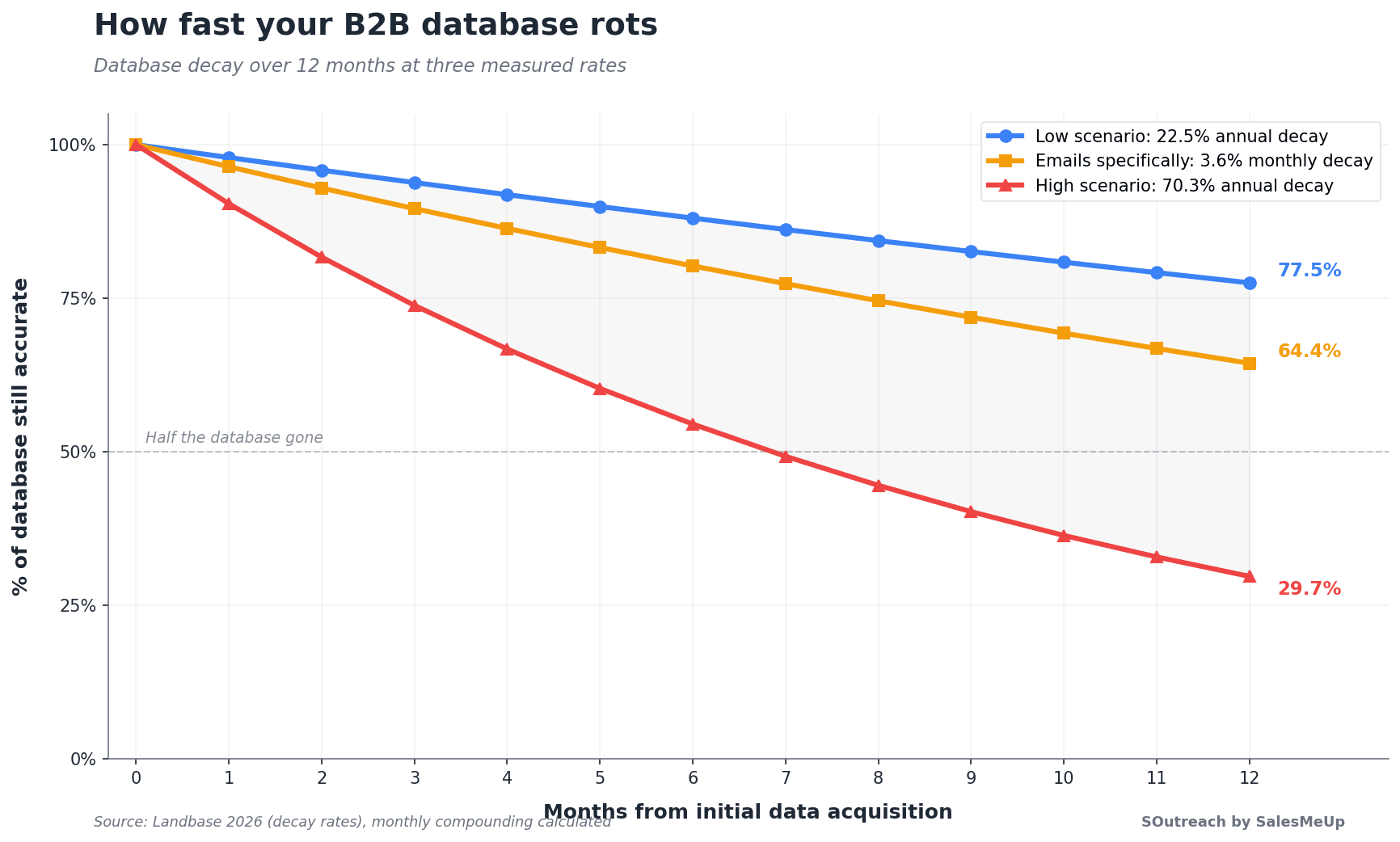
According to the Landbase 2026 report, B2B contact data decays between 22.5% and 70.3% annually, and emails themselves rot at 3.6% per month (as of November 2024). Translated into plain English: nearly three quarters of your database can be outdated within 12 months. According to IBM, poor data quality costs the U.S. economy $3.1 trillion per year. That includes lost campaign revenue, the time sales and marketing teams spend fixing errors instead of doing actual work, bad decisions based on bad data, plus extra maintenance and compliance costs. The number is from 2016, and IBM even pulled the original infographic, but the figure still gets cited everywhere. And what matters: follow-up research from Experian, IDC and Salesforce confirms the scale of the problem.
Salesmotion in January 2026 reports that static databases lose 25 to 35% of their value each year. And there's more. Sales reps spend 20 to 30% of their time dealing with data quality issues: hunting down updated info, deduplicating records, cleaning up after failed outreach. A Salesforce study found SDRs actually sell only 28% of their working hours. Despite that, very few companies offload prospecting from them to dedicated roles.
RocketReach takes it a step further. In the 2025 Validity survey, 37% of CRM users reported revenue loss as a direct result of poor data quality. This isn't abstract. These are people who lost a deal because they called someone who no longer worked there.
Cleanlist breaks down the mechanics: 15 to 20% of professionals change jobs each year. Average tenure at a company is now 4.1 years, and in tech it's even shorter, often 2 to 3 years. A single job change invalidates most of the fields in a contact record: direct dial, email, title, sometimes even industry.
3. BZ WBK and J. Rockcliff Realtors are still alive in databases. Or, why companies change faster than databases
Open Apollo. Search for "BZ WBK" (a former leader of the banking sector in Poland and Germany). What do you find? Profiles of people assigned to a company that hasn't existed for over 20 years. The bank was acquired by Santander a long time ago, and on top of that Santander itself was recently acquired. But in the database, BZ WBK is still living its best life along with its former employees.
Second example, more recent and even more striking, this time from the U.S. J. Rockcliff Realtors was a premier residential real estate firm in the San Francisco East Bay, peaking at over 530 agents. On July 2, 2020 it was acquired by Sereno Group, and its agents scattered to other brokerages in the following years, Compass among them.
In Apollo, J. Rockcliff Realtors is still casually listed as a real estate company with 110 employees. You click on one of these "employees," Robert Combs, and you land on his personal agent page at Compass: https://www.compass.com/agents/robert-combs/. So a company that hasn't existed for over 5 years has 110 "employees" in your database, who are in reality agents at completely different firms or working independently. You send a campaign to J. Rockcliff? It hits a void. You send those 110 people offers for real estate agent partnerships? Most of them moved to the competition long ago.
This isn't a one-off bug. It's a systemic problem. Landbase puts it bluntly: about 15% of companies undergo a reorganization, merger or major structural change each year. Every one of these events (mergers, acquisitions, rebranding, expansion, downsizing, relocations, new funding rounds, bankruptcies) can change a company's name, location, ownership or key contacts overnight.
When two companies merge, some contacts get new email domains, others get laid off. When a startup raises a round, mass hiring kicks in. New roles, new territories, new decision makers appear. When a company folds, huge chunks of your database become worthless in a single day.
Now think about this: if your AI SDR is running on this data and doing outreach "autonomously," you're sending fully formed campaigns to zombie companies. Lovely.
4. Market leaders under the microscope: Apollo, Lusha, ZoomInfo, Dealfront
Let's see how the market leaders handle data freshness. Not vendor marketing claims, but independent testing.
Apollo: big database, low accuracy
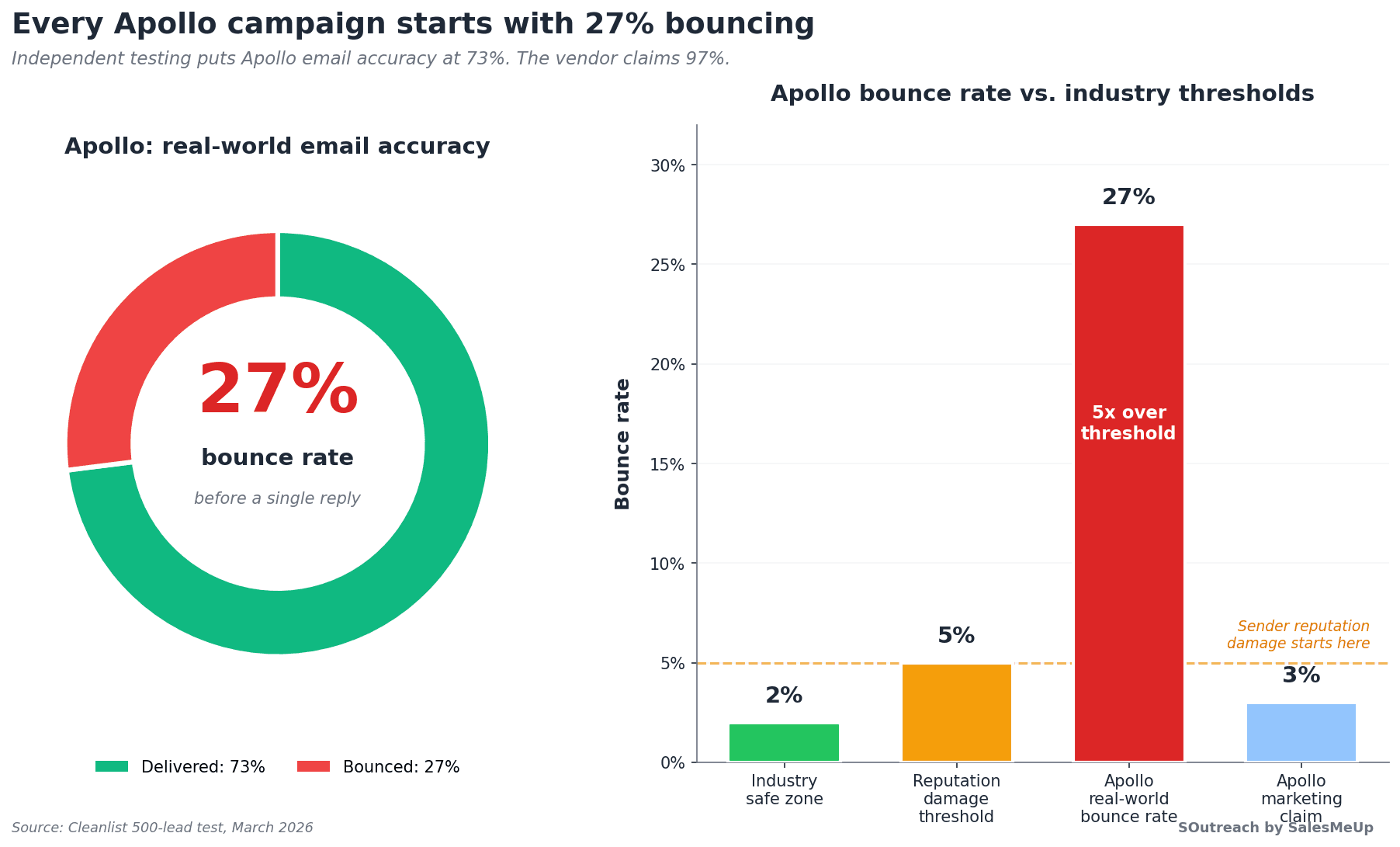
Apollo currently boasts 275+ million records. Marketing-wise, it sounds great. In a March 2026 500-lead test by Cleanlist, Apollo's real-world email accuracy came in around 73%. That means one in four emails in your campaign will bounce immediately, before anyone reads the subject line. And what about company data? Why does nobody ask about that?
Cleanlist adds important context: a bounce rate above 5% already damages sender reputation. At 73% accuracy, you're starting every campaign with a 27% bounce rate, long before anyone replies. Your domain reputation tanks, deliverability drops, and your next campaigns end up in the spam folder.
Apollo markets itself with a 97% email accuracy claim. Independent testing tells a different story. Who you believe is up to you.
Lusha: simple, but superficial
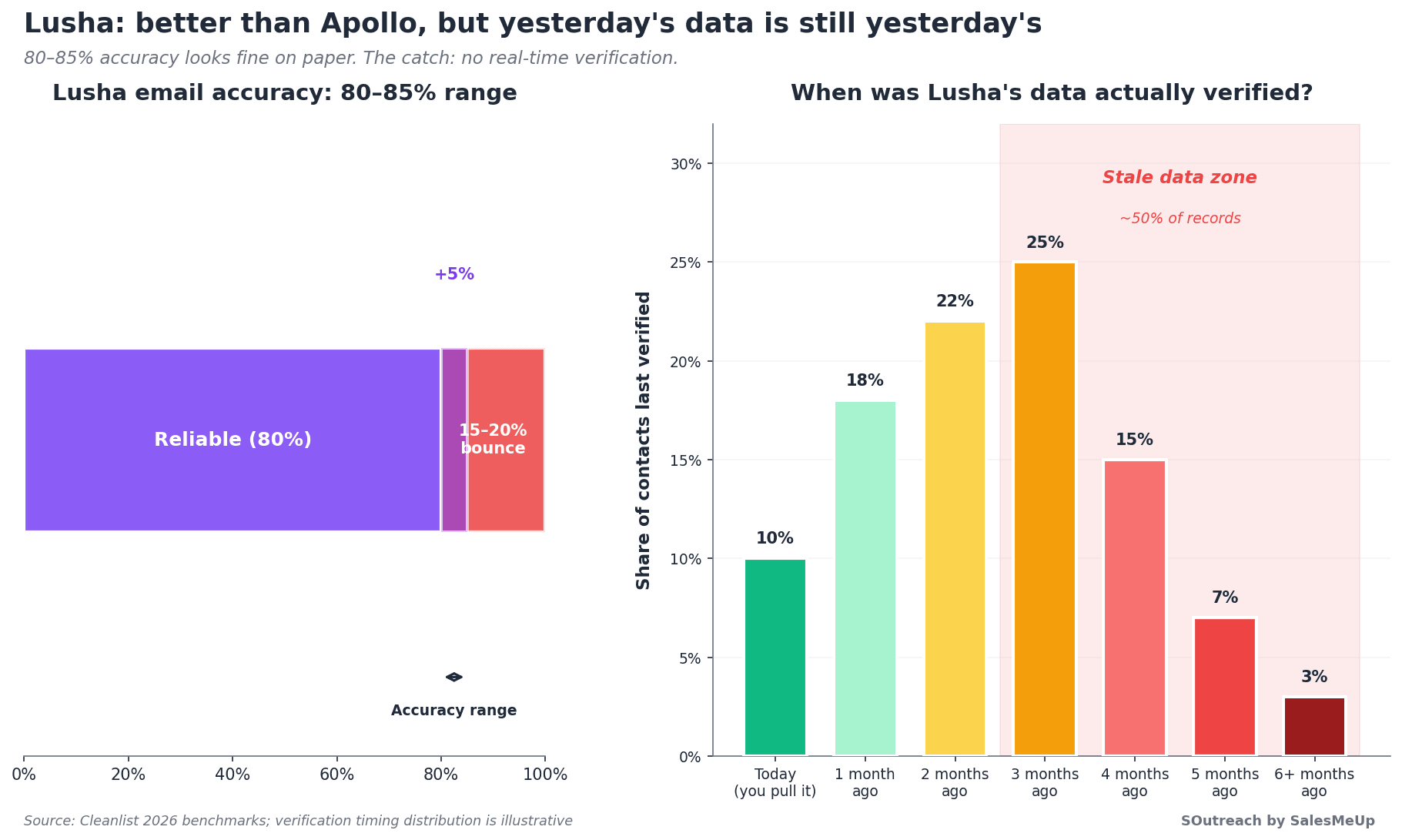
Lusha keeps email accuracy in the 80 to 85% range. Better than Apollo, but Cleanlist points to a different issue: Lusha doesn't verify data in real time. A contact you pull today may have been last verified months ago. In the meantime, that person changed jobs, the company changed domains, and you'll only find out after the bounce.
Second thing: Lusha focuses on contact data. Great. But what about company data? What does that company actually do today, not five years ago when they last updated their profile? Lusha won't tell you. I'll just add my rhetorical "Why?"
ZoomInfo: priciest, most accurate
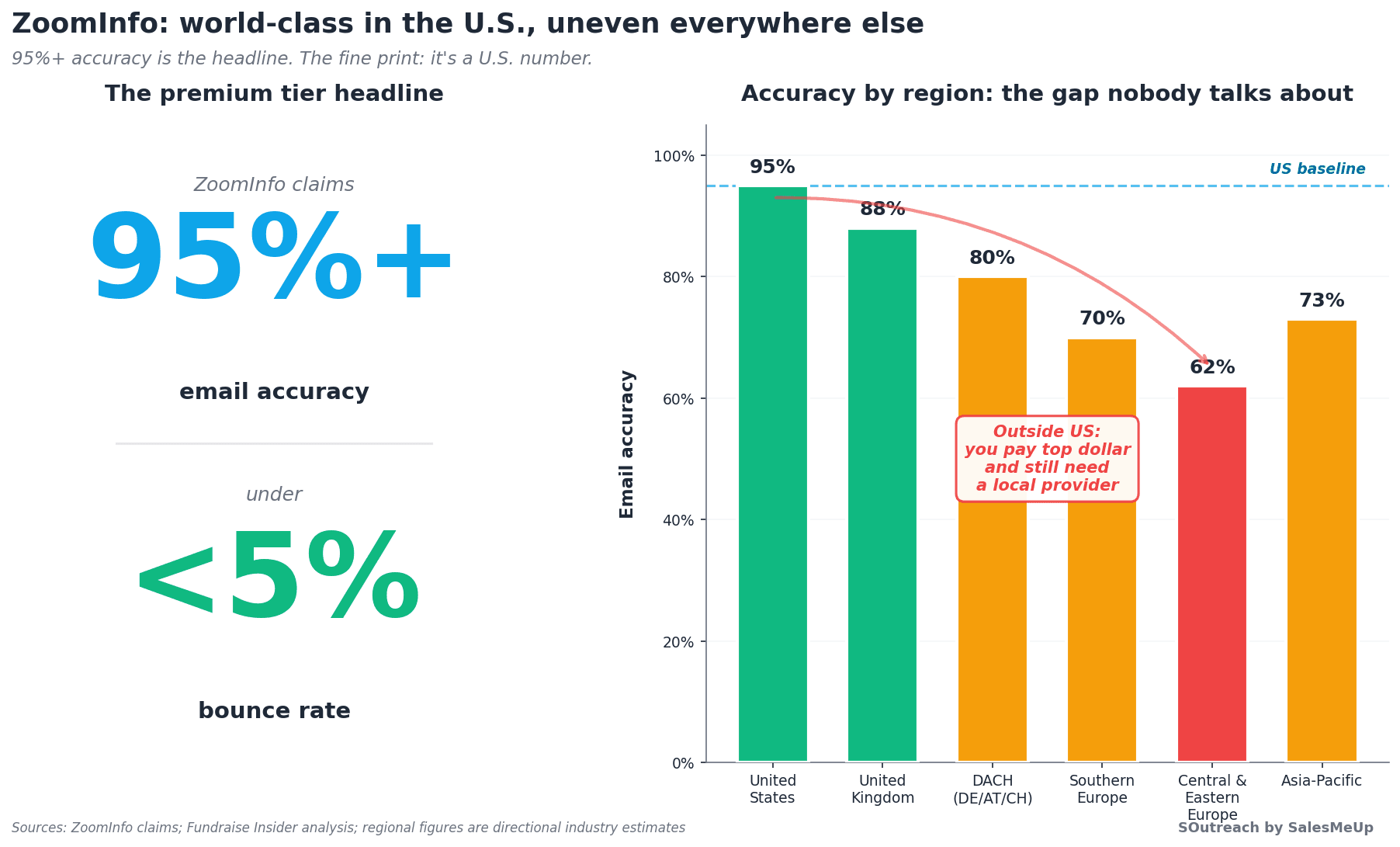
ZoomInfo claims 95%+ accuracy and under 5% bounce rate. They do a lot to maintain that number: AI, human researchers, contributor networks. For the U.S. market, that really is top tier.
But there's a "but." Fundraise Insider notes that ZoomInfo's data quality isn't uniform. Users report that accuracy drops noticeably outside its core markets. In Europe, you often have to supplement ZoomInfo with a local provider like Cognism or, you guessed it, the German Dealfront. So you pay the most, and in Europe you still have to pay extra.
Dealfront: the German answer to American giants
Dealfront was born in 2023 from the merger of German Echobot (Karlsruhe, 2011) and Finnish Leadfeeder. German HQ, 180 people, 30,000+ customers across Europe, more than 210 million euros in funding. Today it's the strongest European B2B data provider.
What matters from a freshness perspective: Dealfront pulls data from official European commercial registers. Not from scraping LinkedIn profiles, but from what companies are legally required to keep up to date. Their crawlers scan the web daily, with refresh cycles ranging from real-time to 12 to 16 weeks depending on the data type.
This approach is closer to what I'm aiming for in SOutreach: we start with the company, not the contact. Dealfront's weakness: Southern and Eastern Europe are much less covered. Poland, Czechia, Spain, Italy. The database is thin here. And Poland is a country that grew its economy 17 times over in the past 30 years.
5. AI SDR. Why automation on dirty data burns budget faster
AI SDR sounds like the holy grail of B2B sales. An autonomous agent that finds leads on its own, writes emails on its own, books meetings on its own. How much of that is true?
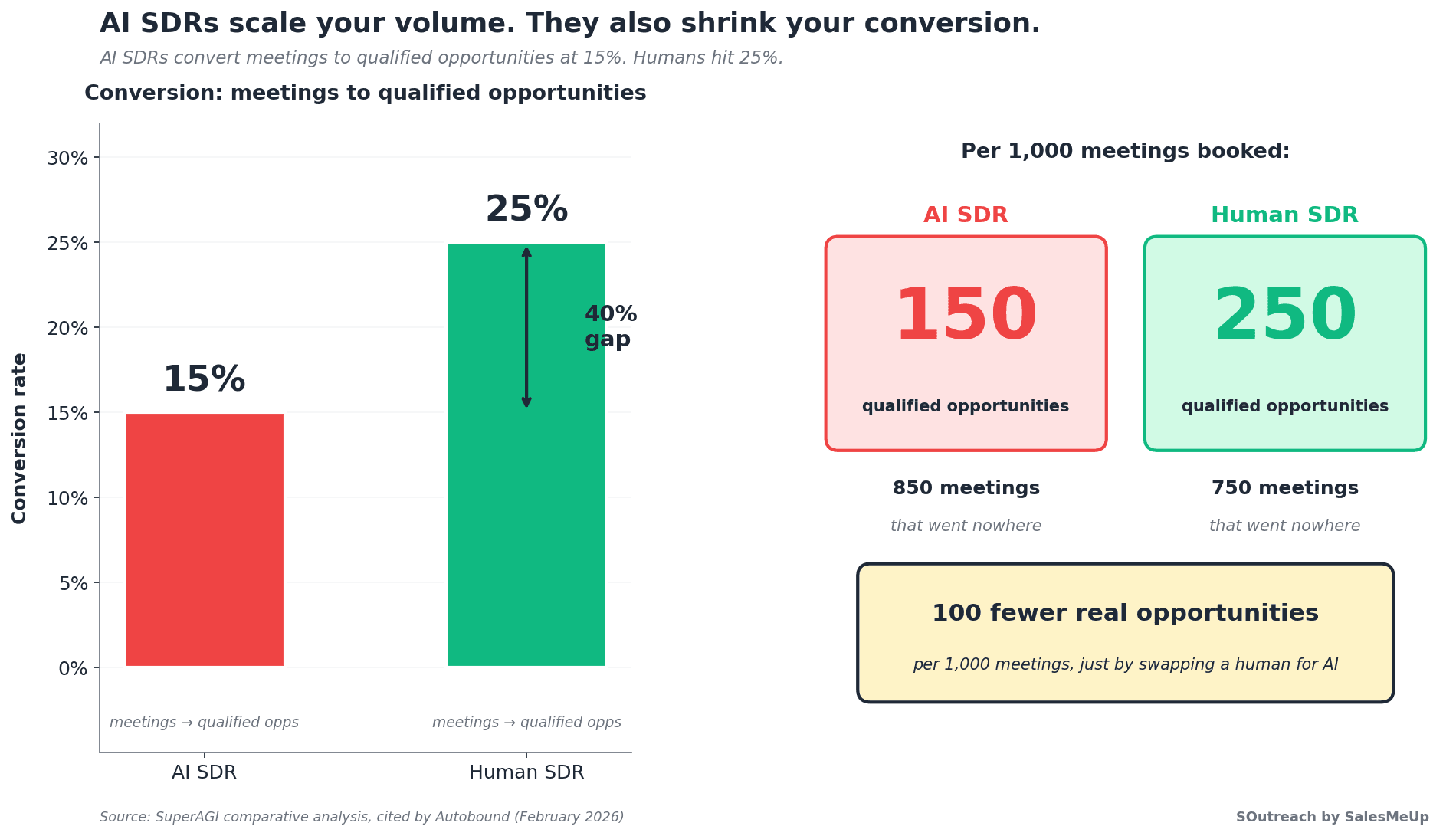
Autobound in February 2026 cites a SuperAGI analysis with a brutal number: AI SDRs convert meetings to qualified opportunities at 15%, human SDRs at 25%. A 40% gap in performance. Where does it come from? Gaps in relationship building, objection handling, and contextual judgment. In other words, the stuff AI still can't do well.
I'll quote Autobound directly: "Volume goes up. Unit economics improve. But lead quality and conversion quality often go down unless the tool is built on genuinely strong signal intelligence."
In other words: without genuinely good input data, an AI SDR is just a faster way to send spam. Volume goes up, quality goes down. What's the point of sending 10,000 emails instead of 200 if every one of them lands on a nonexistent contact at a company that no longer goes by the name you addressed?
I know what I'm talking about. I test various sources that claim high quality, and not a week goes by without me catching some kind of mess.
Apollo itself admits this in its 2026 materials: data quality and CRM hygiene are now baseline requirements for AI to make sense in prospecting. Which is what I've been saying from the start: get your data in order first, then automate.
6. What worked for me: 3 months of R&D at SOutreach
I naively assumed last November that I'd solve the data freshness problem at SOutreach in a month. I spent a month just figuring out what I was actually dealing with.
The first few weeks I spent trying to improve contact data. Checking emails, phone numbers, job titles. Results were better than Apollo, but contact data wasn't the actual problem. Contact data only matters once you've made a decision: was it sourced legally or not?
I was still losing tons of leads to changes in the companies themselves. The prospect would write back: "We haven't produced that for 2 years." Or: "We sold that business line last year." Or "I don't work there anymore." How do you prove that a week ago they had that company name listed as "current" on LinkedIn? Are you going to screenshot every record before every campaign?
That's when I grabbed onto what other tools don't do: company verification. Not just domains and names. A real, current description of business activity based on the current website, recent blog posts, recent job postings. Because job postings happen to be the fastest signal of where a company is actually heading.
After three months of R&D we had a working flow that verified the whole database: companies, contacts, roles, context. And I'm still tuning the freshness logic (we're now in May 2026, six months past the deadline I gave myself to crack this). Because some companies reorganize slowly, others change their offerings every quarter. There's no single refresh cycle that works for everyone.
The takeaway? Data freshness isn't a problem you solve once. It's an ongoing process. Anyone who promises you 100% freshness in a one-time fix is either lying or doesn't know what they're talking about.
7. What should be verified before outreach
Here's a checklist. Not a marketing one. The one I actually use:
Company name is it still the same name? Was it acquired, renamed, sold? Think this only happens to small entities? I emailed Autopay, a company with $0.28B in annual revenue that changed its name from BlueMedia to Autopay in 2023. Guess which name I found in databases in January 2026?
Current business description not the one from 3 years ago on LinkedIn, but from the current website, job postings from the last 90 days, recent press releases
Industry and sub-industry does the company still do what you bought as a tag from the database? Apollo and Lusha tag automatically and sometimes it gets comical
Company size Apollo shows employee counts from LinkedIn, which are often inflated by former employees or by regions where the company no longer operates
Location of actual operations HQ in one country, sales run from another
Tech stack if you sell an integration, check whether the client still uses what you integrate with
Corporate events mergers, acquisitions, funding, layoffs from the last 6 months
Persona's job title the freshest one, not from a year ago. Lusha and Apollo notoriously show outdated titles
Email with real-time verification, not last checked three months ago
Phone direct, mobile or main line. Most databases don't distinguish
Any one of these can blow up your campaign. Checking all of them sounds like a lot of work. Because it is. But the alternative is burning your domain, burning your brand and burning your budget on tools promising you the moon.
8. Q&A
Q: Why isn't contact enrichment enough?
A: Because the company as an entity changes faster than any one contact inside it. According to Landbase, around 15% of companies go through structural change each year, while overall B2B database decay reaches 22.5 to 70.3% annually. If you only enrich emails and phone numbers, you're still aiming offers at entities that may no longer exist in their previous form.
Q: Which database has the highest real-world data accuracy?
A: According to independent tests (Cleanlist, RocketReach), ZoomInfo holds 95%+ in the U.S., Lusha 80 to 85% globally, Apollo around 73%. For Europe, Dealfront is stronger because it pulls data from official European commercial registers. None of these databases hits 100% and each requires additional verification.
Q: Will AI SDR solve the data freshness problem?
A: No. AI SDRs convert meetings to qualified opportunities 40% worse than humans (15% vs 25% per the SuperAGI analysis cited by Autobound). Without good input data, an AI SDR is simply a faster way to send spam. Apollo itself admits that data quality is now a prerequisite for any sensible use of AI in prospecting.
Q: How often should you refresh a B2B database?
A: Salesmotion suggests quarterly at minimum, but for intent data and contacts in high-turnover industries (tech, finance), continuously. RocketReach goes further and argues for continuous enrichment instead of periodic refreshes. My experience at SOutreach: there's no single cycle that works for everyone. Some companies change once a year, others every quarter.
Q: What is data decay rate and how high does it run?
A: It's the percentage of data that becomes outdated per unit of time. Landbase: 22.5 to 70.3% annually for B2B data. Cleanlist: 22.5% annually, 2.1% monthly. Salesmotion: 25 to 35% annually. RocketReach: emails decay 2.1% per month. Why the differences? Each measures different data types, in different industries and regions. Practical takeaway: assume at least 25% annually for your database.
Q: Is Dealfront worth investing in if you already have ZoomInfo?
A: If you sell mainly into DACH or Scandinavia, yes. Dealfront pulls from local commercial registers and has stronger firmographic data in that region. If you sell globally, ZoomInfo + Dealfront for EU is a common stack at larger teams. If you sell mainly into CEE, Dealfront is weak here and you're better off looking for alternatives or doing your own enrichment.
Q: What should my team verify most urgently before the next campaign?
A: Three things in this order: 1) current business description (does the company still do what you targeted them for), 2) the persona's current job title (does that person still work there in that role), 3) real-time email deliverability. The rest (size, location, technologies) matters, but these three decide whether the email even reaches the person it's meant for.
Sources
| Publisher | Link |
| Landbase: Data Decay Rate Statistics 2026 | https://www.landbase.com/blog/data-decay-rate-statistics |
| Cleanlist: Lusha vs Apollo 500-Lead Test | cleanlist.ai/blog/2026-03-07-lusha-vs-apollo |
| Landbase: Why B2B Data Goes Stale | landbase.com/blog/why-b2b-data-goes-stale |
| RocketReach: B2B Data Accuracy Trends 2026 | rocketreach.co/resources/b2b-data-accuracy-trends-essential-2026-statistics-and-insights |
| Cleanlist: B2B Data Decay Statistics | cleanlist.ai/blog/2026-01-22-b2b-data-decay-statistics |
| Salesmotion: B2B Contact Data Quality Guide | salesmotion.io/blog/b2b-data-quality-guide |
| Autobound: Best AI SDR Tools 2026 (citing SuperAGI) | autobound.ai/blog/ai-sdr-tools-guide |
| Dealfront (DE): The Most Accurate B2B Data for Europe | leadfeeder.com/our-data |
| CheckThat.ai: Dealfront Profile | checkthat.ai/brands/dealfront |
Dobrosław Duszyński
SalesMeUp