
Philosophy vs. Code: Why Salespeople Matter in the Race for the Best Prompts
Table of Contents
- The Return of the Philosophy Major
- Why logic is the new interface for AI
- Thinking vs. Programming in B2B sales
- Why Your Developer Will Ruin Your Prospecting
- The trap of "if X, then Y" logic in human relationships
- The "Thermomix" myth of fully automated sales
- Why conceptual precision is the secret to non-generic content
- Intent Engineering: Syllogisms in the Service of Sales
- Prompting as formalized argumentation
- The Socratic "Why?" in customer research
- A philosophical definition of a "lead"
- Locality: Your Secret Weapon That Bots Do Not Grasp
- Why AI fails at regional nuances
- The "Midsommar" test: Human judgment over global scale
- The Seneca and "Persistent" Strategy
- Omnia adversa exercitationes putat: Adversity as training
- Patience over binary results: The 31-month conversion cycle
- HubSpot vs. Apollo: Why Your CRM Needs an Exorcist
- The "for your review" dilemma in AI agents
- Data flow vs. cognitive value
- The ethics of quality over quantity in lead scoring
- SOutreach: Beyond Developer Algorithms
- Ontology vs. Scale: Why standard databases fail
- Human-centric data analysis for 77% higher accuracy
- The cost of getting it wrong: "Hey Buddy" vs. the €500k contract
- Summary: Logic as the Ultimate Sales Strateg
The Return of the Philosophy Major (With Logic in Tow)
For the past two decades, humanities graduates, especially philosophy students, were the punchline of jokes about using their degrees to work in fast food. Today, those jokes are just stale relics from the 90s used by law, med, and tech students to make themselves feel better. We have entered the era of Generative AI, where language has shifted from a tool for describing the world to an interface for controlling the most powerful technology of our time. Consequently, a philosophy graduate with a top grade in logic now finds themselves on a level playing field with specialists who spent years studying law, technology, or medicine. This does not mean specialists are no longer needed, but they are certainly no longer indispensable in many fields. If you sell in a B2B model, you must understand this: AI does not need a programmer to function. AI needs someone who knows how to think.
Why Your Developer Will Ruin Your Prospecting
Developers are trained to think in terms of syntax and functions: if X, then Y. This approach is excellent for building a CRM but disastrous for building human relationships. When a developer writes a tool or a prompt for a salesperson, it usually results in something that functions but does not necessarily align with the salesperson's goals. For example, in Apollo.io, you can use custom prompts for every row in a database. You can ask if a lead's company offers B2B or B2C services or generate a message for a specific person.
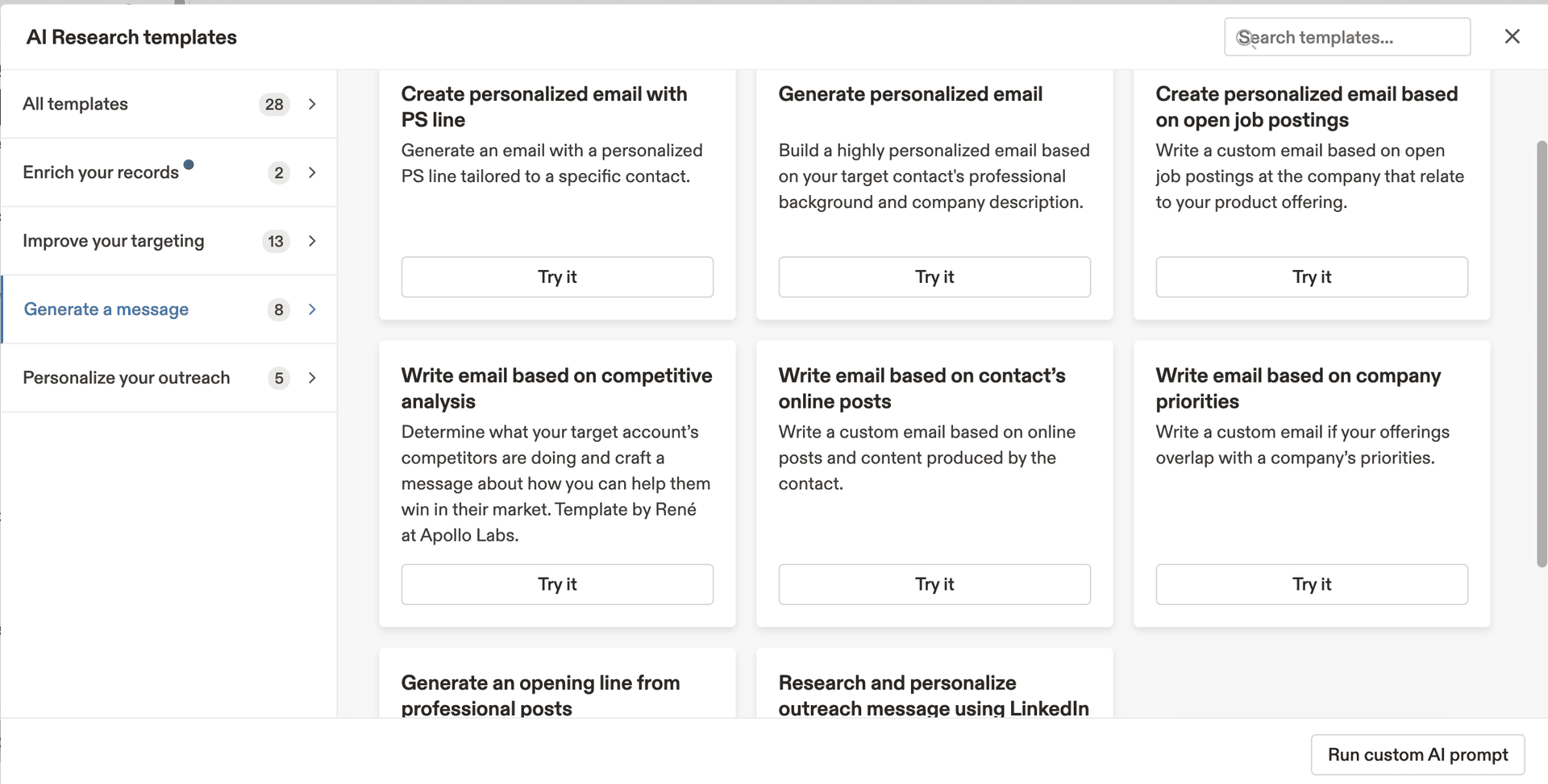
Looks powerful, doesn't it? But how does it actually work? Well, in the campaign preview, you might find that the dynamically generated content doesn't match what you see in your contact table because it gets generated during the campaign itself.
Classic developer logic, right? The function exists, it generates content, and it allows you to insert that content into a campaign. It doesn't matter that it becomes risky for a user who lacks proper training. And Apollo is just one of many systems that has implemented Agentic AI for sales.
If you believe companies promising that their AI Sales SDR or Prospector will find leads and handle prospecting all on its own, you probably also bought a Thermomix thinking it cooks soup by itself. After you chop the vegetables, measure the ingredients, and toss them into the machine, you hit start instead of turning a dial on an induction stove. That does not mean the soup made itself. I assume, however, that you are not the kind of person I can charge €50 to explain why they do not need to spend €50. It is surprising how often we let ourselves be used by companies that claim they will do something for us as long as we do A, B, C, and D first.
A philosopher and any sharp salesperson with a humanities background knows that conceptual precision is 90% of the battle. AI does not guess your intentions. If you do not define a customer's problem to its very core, the way Plato or Kant taught, the bot will give you generic fluff that nobody will read. At SalesMeUp, we see this every day. We have generated $1,000,000 in revenue for our clients from LinkedIn leads, a platform many claim is too spammed to work. This success comes from someone knowing how to ask AI about the essence of a persona rather than just their database parameters.
Intent Engineering: Syllogisms in the Service of Sales
Most people think Prompt Engineering is some magic art of typing in keywords. It is not. It is simply formalized argumentation.
- Logic over code: If you can build a syllogism, you can program AI to personalize cold emails so they do not look like spam.
- The Socratic "Why?": Instead of asking AI how to write an email, the salesperson-philosopher asks about the practical concerns a logistics director in the UK has when considering a change in CRM providers.
- Defining a "lead": Most companies struggle with this. We define it through specific interest and a scheduled meeting. This philosophical approach ensures we do not waste time on prospects that will never become opportunities.
Locality – Your Secret Weapon That Bots Do Not Grasp
AI is excellent at a global scale but fails when it comes to locality. This is where the human salesperson comes in. You can use AI to appear local, from using virtual addresses to adjusting the language. However, you are the one who has to judge if it is wise to send emails in Scandinavia during Midsommar. Hint: it is not, as everyone is out celebrating. AI does not feel these nuances, so you have to be the one to tell it.
Omnia aduersa exercitationes putat (He regards all adversity as training - abou the presistent of the Wise).
The Seneka and Persistent Strategy.
In B2B sales, the longest conversion we have recorded lasted 2 years and 7 months. Programmers want results right now, in binary terms. A philosopher knows that building relationships is a process that spans quarters. That is why our Lead Nurturing is not an intrusive newsletter, but personal communication that builds a relationship step by step.
HubSpot vs Apollo, or why your CRM needs an exorcist (and a philosopher)
In the world of B2B sales, there is a cult of tools. The most common myth I hear is: "We'll buy an AI SDR, plug it into HubSpot, and leads will just fall into the funnel". The reality? An AI SDR requires implementation. How is it that a powerful multi-platform designed to work for you still needs you? Well, it is simple:
Artisan’s Ava is an AI sales agent that automates the entire outbound sales process. Ava helps sales teams generate more qualified leads faster—without the need to grow the headcount. Ava uses conversational intelligence to gather data about your ICP and your goals through a simple chat interface. As you interact with her, Ava taps into her database of over 300 million contacts to identify leads that match your ICP. Then, she crafts personalized emails for each lead and presents them to you for review.
That last sentence is telling: "for your review". What happens if you do not have the knowledge needed to approve them?
A programmer will tell you: "The API is working, data is flowing". A philosopher will ask: "But does this data have any cognitive value?". At SalesMeUp, we know that integration is just the beginning. The real work starts with scoring and segmentation. If you mindlessly pump thousands of records into your CRM, all you achieve is clogging the funnel with "trash" that your sales department will have to manually clean up for five hours a day. We use logic to separate prospects from real opportunities. In sales, much like in ethics, it is not the quantity that matters, but the quality of the actions taken.
SOutreach – Because Developer Algorithms Can't Tell a "Hey Buddy" From a "Dear Sir"
This brings us to the heart of the matter. Why did we build our own application, SOutreach? Because the public data available on the market is often about as accurate as a morning newspaper horoscope. The statistics are brutal: 9 out of 49 records from popular databases don't even match the job title, and industry error rates reach 43%.
Developers creating mass prospecting tools focus on scale. We focused on data ontology. Thanks to SOutreach, our databases are anywhere from 20% to 77% more accurate than what you can buy "off the shelf". Why? Because we taught the system to look at a company the way a human does—analyzing not just tags, but the actual website content and market context.
In outbound sales, the "rule of locality" is sacred. If you are sending an email to a Swede from an office in Katowice, you have to sound like someone who understands their market, not like a bot from across the ocean. SOutreach allows us to catch these nuances that an AI SDR misses. It is the difference between a "Hey buddy!" sent to a bank president and a precisely tailored message that opens the door to a 500,000 euro contract.
To sum up: if you have someone on your team who can challenge AI with logic rather than just code—hold onto them. They are the ones who will write the sales strategy while others wonder why their generic bots aren't delivering results.
Want to see how a "philosophical" approach to data delivers leads in your industry? Let us know—we will create a sample for you that proves the difference
Sources: https://hbr.org/2023/06/ai-prompt-engineering-isnt-the-future
https://www.thelatinlibrary.com/sen/sen.prov.shtml
Q: Why is SOutreach better than standard B2B databases?
A: Standard databases generate errors between 18% and 43% in critical fields such as job titles or industries. SOutreach uses more advanced persona matching, which improves data accuracy by as much as 77%
Q: Which tools are best for identifying anonymous website visitors in Europe?
A: The choice depends on your specific needs: Snitcher integrates well with HubSpot, Dealfront is a leader in the European market, and Albacross is helpful for marketing automation. However, the tool itself is not the key factor; the way a human verifies that data is what matters most.
Q: How long does it take to acquire the first customer in a new foreign market?
A: Realistically, you should expect it to take between two and six quarters. The first year is generally focused on gathering feedback and validating your value proposition rather than achieving mass sales.
Q: Is it worth automating prospecting on LinkedIn?
A: Yes, but only if the automation supports a personal relationship. Without human oversight and a proper lead nurturing scenario, automation simply becomes a spam generator that damages your reputation in the market.
Q: What is the difference between Prompt Engineering for a salesperson versus a programmer?
A: A salesperson-philosopher focuses on psychology and the logic of argumentation, whereas a programmer focuses on syntax and data structure. In B2B sales, it is the understanding of customer intent that drives higher conversion rates rather than pure technology.
Q: How does a humanities education impact database quality?
A: It allows for better verification. Automated databases often have error rates between 18% and 43%. A humanist knows that without manual verification and a "human eye," you are simply paying for junk records.
Q: Is it worth investing in cold leads in 2026?
A: Yes, because 81% of companies buy from the provider they established contact with first. Properly "warmed up" cold leads eventually yield conversion rates similar to those of referrals.
Q: How can you ensure a company is treated as a local entity abroad?
A: AI can help you with translation, but you must take care of a local domain, a phone number, and—most importantly—case studies from that specific market. Locality is not just about language; it is about business context.