
AI in Sales 2026: 8 Reasons B2B AI SDRs Are Failing (And What Actually Works Instead)
AI in Sales 2026: Why a $350M Startup Faked Its Customers, and Your Team Is Burning Cash on a Bot That Doesn't Work
Table of Contents
- What You Actually Buy When You Pay $5,000 a Month for an AI SDR
- The 11x Scandal: How a $350M Startup Faked Its Customers (And Why Investors Swallowed It)
- Alice Hallucinates, Client Cancels in 48 Hours: Anatomy of One LinkedIn Screenshot
- The Bubble Pops: 50-70% of AI SDR Projects Die Within 90 Days
- Gartner Says What AI Vendors Won't: 40% of Projects Go to the Bin
- Cold Emailing Killed by AI (Or How Gmail Learned to Sniff Out Gemini)
- What Works in 2026: Hybrid, Philosophy, Local
- Q&A: Most Common Questions About AI in Sales 2026
- Sources
1. What You Actually Buy When You Pay $5,000 a Month for an AI SDR
Picture this scene. Your CFO walks up to you with a deck from some hot Silicon Valley startup. The slides have animations. The logo looks straight out of an Apple ad. On the demo, an agent with a human first name writes a personalized email for a prospect from your market. The salesperson tells you: one such bot replaces 11 headcount. You pay $5,000 a month and you're free.
Know what you bought? You bought a Thermomix. The same one I wrote about before. The bot will "make leads for you," right after YOU sort the data, build the ICP yourself, train the model on your own materials, approve EVERY single message before it goes out, and check daily whether the bot isn't contacting your existing clients. Oh, and you'll fix the data in the CRM, because the bot trashed it.
I've been selling outbound since 2015. I've seen the exact same movie in three versions: "marketing automation will sell for you" (2012), "chatbots will sell for you" (2018), "AI SDR will sell for you" (2024). Every wave needs EXACTLY THE SAME amount of human work. Just redistributed.
This article isn't about AI not working. AI works great, where you know what it should do. This article is about why the loudest AI startup for B2B sales in 2024 turned out to be a piece of PR-polished garbage, and why Andreessen Horowitz and the rest of the cap table probably won't see a cent back on their $50 million. This is the story every head of sales should know before signing another annual contract with a "digital workers" vendor.
2. The 11x Scandal: How a $350M Startup Faked Its Customers
On March 24, 2025, TechCrunch published a piece that hit the AI SDR category like Oleksandr Usyk knocking Tyson Fury off his feet the first time. It stopped the whole space mid-stride. 11x.ai, the genre's poster child, backed by a16z and Benchmark, was valued at $350 million, marketed as the Spotify of B2B sales, and selling a vision where one bot replaces 11 humans.
Except, as TechCrunch revealed, most of that vision was literally made up.
And then there's me. As an honest builder of the LLM prospecting agent SOutreach, I have to show on a demo that what I can do actually works, and my clients know what references I'm putting on the screen.
ZoomInfo: "We're not a customer. Take our logo down"
ZoomInfo's logo was sitting on the 11x site as a "customer." A ZoomInfo spokesperson told TechCrunch flatly: "We did not give them permission to use our logo in any manner, and we are not a customer." The logo came down only AFTER the TechCrunch journalist started asking questions. What's more, 11x's phone bot was still telling people ZoomInfo was a customer long after that.
ZoomInfo ran a one-month pilot of the 11x product, mid-January through mid-February 2025. Verdict? "During the pilot, 11x's product performed significantly worse than our SDR employees and we did not proceed." So the company that literally sells sales data tested an AI SDR and said: thanks, our humans are better.
Airtable, Twilio and the rest: same playbook
Airtable also had its logo on 11x.ai as a "customer" on the manifesto page. Airtable confirmed to TechCrunch it was never one. They ran a short test in late 2024 and decided the product wasn't a fit. The logo stayed on the 11x site through March 21, 2025. Five plus months later.
Question of the kind a student of Socrates would put to the master: if you're showing something that never happened as something that is, is that brilliant foresight, or just sloppy sophistry meant to fool the crowd?
A three-month trial counted as an annual contract
The second 11x number trick: ARR. Annual Recurring Revenue, the holy cow of SaaS. 11x reported hitting $10 million ARR in under two years. Sounds impressive.
Problem? Customers were signing 1-2 year contracts, but with a break clause after 3 months. And as TechCrunch revealed, most early customers walked at exactly the 3-month mark. 11x was counting those short contracts as full annual ARR. That's why the company "grew like crazy" in investor decks, but in reality had gross retention below 50%.
Let me put it simpler. If someone asks how much you make per month and you multiply your salary by 12, fine. But if you quit your job after one quarter and you're still telling people "that's my annual income," that's a lie. 11x did exactly that.
"The products barely work" - quote from a former engineer
A former 11x engineer told TechCrunch, short and sharp: "The products barely work." Customers complained about hallucinations, the product not loading, and having to manually check and fix everything the bot produced.
In other words: you bought a bot meant to take work off your plate, and it ended up giving you extra work, namely cleaning up after the bot. Plus thousands of dollars a month. Plus a wrecked domain reputation, because the bot was firing spam at random people.
3. Alice Hallucinates, Client Cancels in 48 Hours: Anatomy of One Screenshot
The best story in this whole circus comes from my favorite source in the industry, Lead Generation Economy. They wrote up a situation worth remembering. I'm quoting their researchers, who pulled it from LinkedIn:
Alice (11x's prospecting agent) sent an email to the CTO of a mid-market SaaS company. The message opened with a fake compliment about a fundraising round announcement that NEVER HAPPENED. The CTO posted the screenshot to LinkedIn. The post got 4,000 reactions and 600 comments. Two of those comments came from active 11x customers. One of those customers canceled the contract within 48 hours.
Unfortunately, this happens. Edge cases happen everywhere. Half-bad if you mix up the company name or the industry. But when you make up an event that never took place...
Reddit finds the truth faster than LinkedIn
One 11x user described Alice on Reddit even more colorfully. The bot was adding irrelevant companies to the CRM, contacting existing customers of the company, creating hundreds of duplicate records, and generating nonsense messaging. The user called it a "literal disaster."
Same pattern as in my MeetAlfred vs Sales Navigator study: data has to be cleaned, pulled fresh, not pickled in some database. If the data is dirty, AI sends it out the same way you would. Just 1000x the scale.
4. The Bubble Pops: 50-70% of AI SDR Projects Die Within 90 Days
This isn't my opinion. These are numbers GTM AI Podcast got from UserGems, one of the more credible sources in the space. UserGems reports an annual tool churn rate of 50-70% for AI SDR platforms. For comparison, a typical SaaS churns at 5-10% per year. AI SDRs churn TEN TIMES faster.
So you're buying a tool that every other company dumps within the first year. Higher churn than the human SDRs the bot was supposed to replace.
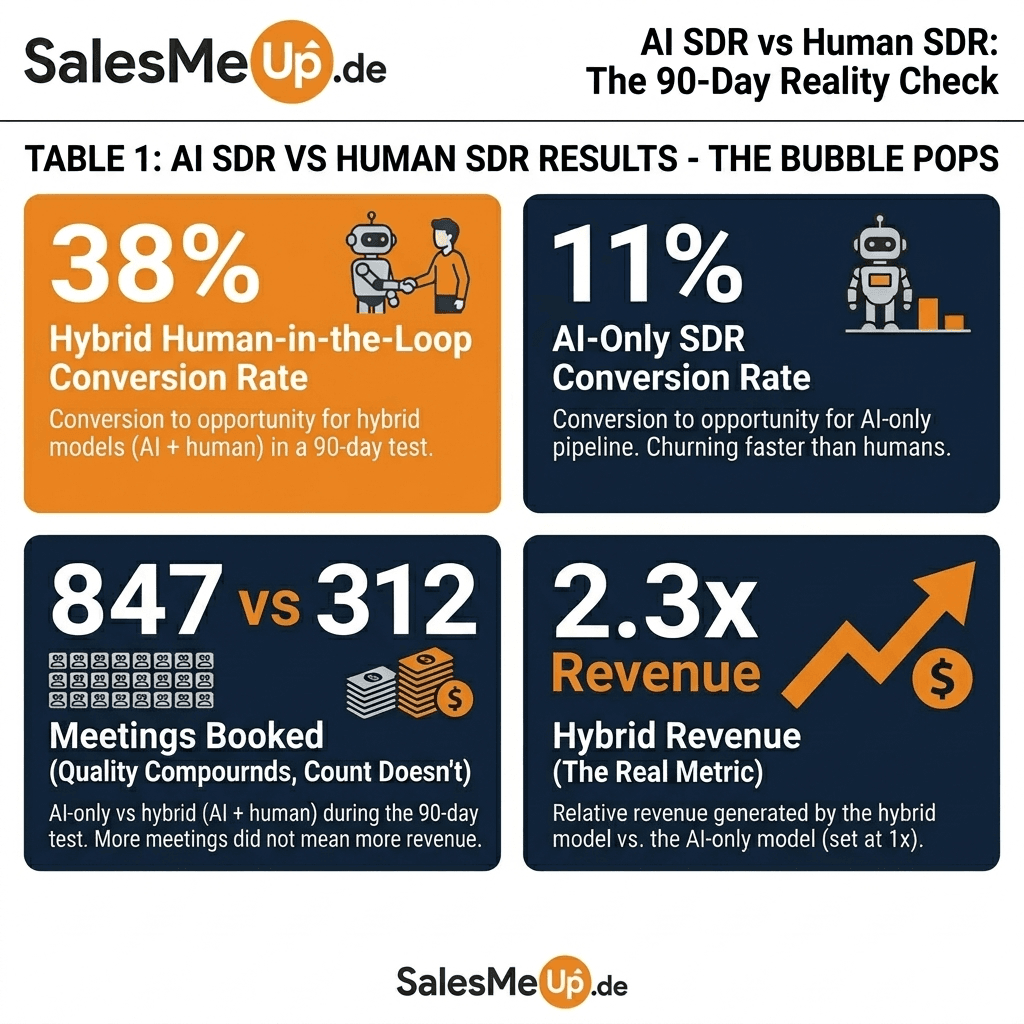
Table: AI SDR vs Human, 90-Day Controlled Test (Human in the Loop, Bitch)
GTM AI Podcast described a controlled 90-day test run by one of their advisory clients. Results below. Read carefully.
| Metric | AI-only pipeline | AI + human (hybrid) |
| Meetings booked | 847 | 312 |
| Conversion to opportunity | 11% | 38% |
| Revenue (relative) | 1x | 2.3x |
Read that slowly. The hybrid booked FEWER meetings. And generated 2.3x MORE revenue. Because meeting quality compounds in sales, meeting count does not.
That's the exact same conclusion we hit at SalesMeUp over 11 years. I don't count gold stars for send volume. I count revenue per lead. That's why I've had a quarter where one campaign generated more revenue than a yearly subscription to tools meant to do it "for me."
S&P Global: 42% of companies abandoned AI initiatives in 2025
Second strong number: per S&P Global Market Intelligence's 2025 survey, 42% of companies abandoned most of their AI initiatives. The year before, it was 17%. So in 12 months, the share of companies pulling the plug on AI grew 2.5x.
This isn't "hype has run its course." This is a mass retreat by companies that bought the autonomous-agent fairy tale and are now discovering that a fairy tale is a fairy tale.
5. Gartner Says What AI Vendors Won't
Gartner. The analyst firm whose slide decks hung in every CIO's office for the past decade. In June 2025, they published a forecast that everyone choosing an AI SDR today should print out and tape to their monitor.
Over 40% of agentic AI projects will be canceled by the end of 2027, due to escalating costs, unclear business value, and inadequate risk controls.
Anushree Verma, Senior Director Analyst at Gartner, said it bluntly: most current agentic AI projects are early experiments driven by hype, often misapplied. Many use cases positioned today as "agentic" don't require agentic implementations at all.
Agent washing: 130 real vendors against thousands of fakes
The strongest line in Gartner's report covers a phenomenon they named "agent washing." Most vendors marketing themselves as agentic AI are rebranding their old products: AI assistants, RPA (robotic process automation), chatbots. With zero actual agentic capabilities.
Gartner estimated that out of thousands of agentic AI vendors, the real ones number around 130. ONE HUNDRED AND THIRTY. The rest is repackaged old toys with an "AI" ribbon on the box.
How does this apply to your buying process? Next time someone walks you through an "AI SDR" demo, ask one question: show me a concrete decision this agent makes on its own that I didn't program. Most of the repackaged "agents" fall apart right there.
November 2025: Gartner discovers that more AI doesn't mean more sales
In November 2025, Gartner published a second forecast, even juicier for sales orgs. By 2028, AI agents are supposed to outnumber human salespeople 10 to 1. Sounds like a revolution, right?
Except, per the same report, fewer than 40% of sellers will report a productivity improvement from AI.
Melissa Hilbert, VP Analyst at Gartner's Sales Practice, put it this way: "AI agents are everywhere, but there's a ceiling of value. Beyond a certain point, more AI does not mean more productivity. Layering on more prompts and tools onto already complex workflows risks overwhelming sellers and accelerating burnout."
So you hire 10 bots per human seller, and that human seller spends half the day cleaning up what the bots produced. Call it whatever you want. I call it double the work for double the cost.
6. Cold Emailing Killed by AI
Here it gets really nasty. Because even if your AI bot works well (hypothetically, you're that 1-in-100 company whose bot actually knows how to write), the mailbox providers will look after you. In the bad sense.
Gmail's Gemini AI vs your AI-generated email
Google built Gemini into Gmail's spam filter. Its primary job is detecting and filtering AI-generated messages. Microsoft rolled out stricter enforcement in May 2025: bounce rate above 2%, spam complaint rate above 0.3%, and your domain takes a reputation hit.
So the filter sitting in your prospect's inbox is artificial intelligence trained specifically to detect your artificial intelligence. AI versus AI, and you're caught in the middle.
Numbers that hurt
- Average B2B cold email reply rate dropped from 6.8% in 2023 to 4-5% in 2025
- 95% of cold emails in 2025 generate ZERO reply (Lavender analysis on over a billion emails)
- Personalization sacrificed for scale and volume drops reply rate 13x
- 45-47% of global email traffic gets classified as spam
- 16.9% of commercial emails never reach the recipient's inbox
GDPR fines: 5.65 billion euros through March 2025
Rui Nunes, one of the more level-headed practitioners in this space, pulled together stats every European head of sales needs to know. Through March 2025, total GDPR fines hit 5.65 billion euros across 2,245 cases. Most common complaint? "I don't know where you got my email."
"I bought a list" is not a defense under GDPR. "Legitimate interest" requires an individual assessment, which is incompatible with sending 10,000 identical emails per day based on a job title. The myth that only big companies get fined is false. Spain alone issued 932 fines through the end of 2024. Most are 5,000 to 100,000 euro fines on SMBs. They just don't make headlines.
At SalesMeUp I've been saying this from day one: if you operate in Europe and you do cold mailing without Individual Outreach (without first establishing contact on LinkedIn, finding shared connections, etc.), you're not asking whether you'll get fined. You're asking when.
My favorite case off LinkedIn
Best spam-comedy of 2025: an email opening with "BTW, this isn't an automated message blasted to 10,000,000 people, I'm a real person and I wrote this manually :)". Two lines below, the body of the email read: "{Company Name}" as an unfilled placeholder.
Buddy. If your bot can't substitute a company name, it's not "hyper-personalization at scale." It's a public faceplant scaled to ten million recipients.
7. What Works in 2026: Hybrid, Philosophy, Local
I showed you the dark side. Time for the constructive part, because I don't sell pessimism. AI in sales has a place in 2026. Just a very different one than what the vendor decks promise.
Rule one: hybrid, not replacement
Strongest data point from the entire research pile (Jason Lemkin, SaaStr): "If you plug in an AI SDR and walk away doing nothing, you get nothing. Zero. Nada." And Lemkin is no AI skeptic. He's one of the biggest bulls in the market. His company needed 47 iterations to get their inbound AI agent to stop being too aggressive on pricing questions. They have a dedicated AI operations person tuning the system every day.
47 iterations. A daily tuning person. That's what a working AI SDR looks like. Not "plug in and walk away."
Stat from the same source: 45% of sales teams have already shifted to a hybrid model. AI handles research, personalization, timing, follow-up sequencing. Humans handle judgment, relationship building, objection handling, and the conversations that actually close deals.
Rule two: AI automates the INPUT, not the OUTPUT
That's a line from my own playbook, but it's well captured in the analysis of the 95% of failed AI pilots: the 95% companies try to automate what the bot says to the customer. The 5% companies that succeeded automate what the bot prepares FOR THE HUMAN, so the human can talk to the customer.
At our place it looks like this. AI in SOutreach handles: persona identification, company data validation, ICP scoring, initial context enrichment about the company. Humans decide who goes into the campaign, handle replies, qualify per BANT. Result? 20% to 77% higher data accuracy than in off-the-shelf databases.
Rule three: local nuance the bot will never grasp
I'm repeating myself, but repetition sells. AI is great globally and terrible locally. The bot writes a perfect English email to a director in Scotland, but doesn't know the Scottish director replies more often when you sign off with "cheers" instead of "best regards." Unless you tell it explicitly. The bot doesn't know Midsommar shuts Scandinavia down for six weeks. The bot doesn't know that a German Geschaftsfuhrer expects different formality than a Polish Prezes Zarzadu.
These are the details that sit between a 5% reply rate and a 25% reply rate. And these are the details an AI sales SDR will never feed you, because those signals aren't in the training data.
Rule four: garbage in, garbage out
Conclusion from my MeetAlfred vs Sales Navigator study: 77 out of 100 records from premium databases fail to meet at least 1 search criterion. If you pump that data into an AI SDR, the AI SDR sends 5,000 emails a day to a set where 77% of recipients don't match your offer. That's not sales automation. That's reputation-burning automation.
Order of operations for 2026: clean the data MANUALLY or with specialized prompts (Google AI Studio is king here). Then segment, by a human. Then, and only then, run the campaign.
8. Q&A: Most Common Questions About AI in Sales 2026
Q: Is it worth buying an AI SDR in 2026?
A: Yes, but only if you already have a WORKING outbound process, tested by humans, with a clear ICP and a defined value proposition. AI SDR scales what's already working. AI SDR doesn't fix what's broken. If your outbound has a 1% reply rate, plugging in an AI SDR gives you a 1% reply rate, just blasted at 10x the scale. Which means 10x the spam.
Q: What does an AI SDR failure actually cost?
A: Direct costs include the subscription (e.g., $5,000 a month at 11x, per third-party estimates), implementation, and team hours on tuning. Indirect costs are scarier: burned domain reputation, lost trust from existing clients (see Allan from TSL Australia), burnout from people cleaning up after the bots.
Q: Why do AI SDRs churn at 50-70%, while typical SaaS churns at 5-10%?
A: Because the promise doesn't match reality. The vendor promises "plug in and go grab a coffee." Reality: 47 iterations, daily tuning, a dedicated AI ops person. Within 90 days, most boards compare the invoice against actual pipeline impact and pull the plug. UserGems confirmed this with research across the whole category.
Q: How do I know a vendor is selling me a real agent and not "agent washing"?
A: Ask one question: show me a concrete decision this agent makes on its own that I haven't programmed. Per Gartner, out of thousands of agentic AI vendors, only around 130 are real. The rest are rebranded chatbots and RPA. Second test: how long is customer retention? If the company has been around two years and the oldest customers have been on it less than 12 months, you should hear alarm bells.
Q: Is cold emailing dying in 2026?
A: Yes, but only the mass-blast version. Mindless cold mailing, built on dirty databases, blasted by AI without personalization, is dying. Reply rates dropped from 6.8% in 2023 to 4-5% in 2025. Meanwhile, highly personalized campaigns show reply rate uplift of 142% against template blasts. Hyper-targeted outreach produces 50% more sales-ready leads at 1/3 lower cost than spray-and-pray.
Q: What happened to 11x.ai after the TechCrunch scandal?
A: The company exists, but gross retention dropped below 50%. Customers started bailing in waves after the March 2025 piece. Glassdoor reviews describe 60-hour weeks, public Slack call-outs, and high turnover. Competitors (like AiSDR) started actively poaching both 11x customers and employees. From a market perspective, 11x became the reference case for "what happens when you sell an AI SDR as autonomy."
Q: Why did LinkedIn ban Artisan AI in January 2026?
A: Contrary to the rumors, LinkedIn didn't ban Artisan for spamming. Two reasons: first, Artisan used the LinkedIn name on its website without permission. Second, it sourced from data brokers who scraped the platform. Two weeks of working with LinkedIn later, they were back. The lesson: your outbound strategy should not depend on a single vendor that depends on scraping a single platform.
Q: What's the real conversion of AI SDR vs a human?
A: In the 90-day controlled test described by GTM AI Podcast: AI-only pipeline produced 847 meetings, 11% conversion to opportunity. AI + human (hybrid) produced 312 meetings, 38% conversion. The hybrid generated 2.3x more revenue from fewer meetings. Meeting quality compounds in sales, meeting count does not.
Q: What should AI in sales do in 2026, and what shouldn't it?
A: Should: company and contact research, data validation, ICP scoring, initial context enrichment, content drafting (for human editing), follow-up sequencing per human-defined rules. Shouldn't: make its own decision about who goes into a campaign, send messages without review, contact existing customers, hallucinate fundraising rounds that never happened.
Q: What do I do specifically if I've already spent $100K on an AI SDR and it isn't working?
A: Three steps. First: stop all campaigns, check your domain deliverability via a tool like MXToolbox or Google Postmaster. Second: manually verify a sample of 100 records from the database the bot is hitting, and count how many are a 100% match to your ICP. Third: redirect 80% of the AI SDR budget toward an experienced human prospector, and keep AI for data enrichment and research. That's the hybrid playbook. That's the 5%-er playbook that actually works.
9. Sources
| Source | link |
| TechCrunch | https://techcrunch.com/2025/03/24/a16z-and-benchmark-backed-11x-has-been-claiming-customers-it-doesnt-have/ |
| Lead Generation Economy | https://www.leadgen-economy.com/blog/ai-sdr-cancellation-wave-failure-forensics/ |
| GTM AI Podcast | https://www.gtmaipodcast.com/p/the-ai-sdr-bubble-is-popping-heres |
| Gartner press release (25.06.2025) | https://www.gartner.com/en/newsroom/press-releases/2025-06-25-gartner-predicts-over-40-percent-of-agentic-ai-projects-will-be-canceled-by-end-of-2027 |
| Rui Nunes (cold email specialist) | https://ruinunes.com/ai-cold-email/ |
| AiSDR blog | https://aisdr.com/blog/ai-sdr-sales-nightmares/ |
| TechCrunch (07.01.2026) | https://techcrunch.com/2026/01/07/yes-linkedin-banned-ai-agent-startup-artisan-but-now-its-back/ |
Want to see if your outbound can run without fake AI SDR and with real data? Let me know. I'll set up a call and we'll run a sample on your data. https://meetings.hubspot.com/dobry-apps
Dobroslaw Duszynski
SalesMeUp Owner